
Mason, OH · Garage Door Service
Attached or Detached: Why It Changes the Door Job in Mason
Mason homes built mostly in the 1960s-70s face different door and opener demands on detached garages than on attached ones. Here's what the age of this housing stock and our cold climate change.
- Repairs & new doors
- Springs & openers
- Serving 5 nearby communities
How Local Conditions Play In
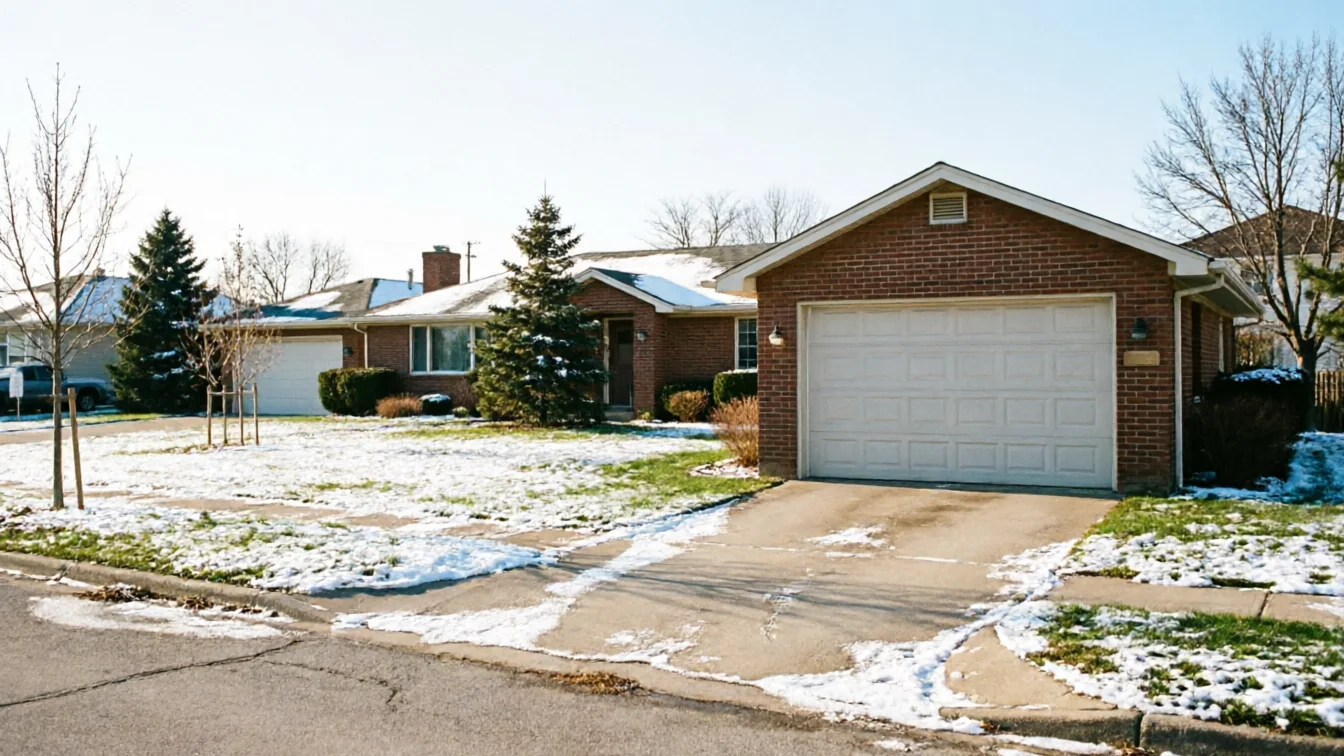
Mason's housing stock runs from 1938 up through 2004, with the median build year sitting at 1972. That means a lot of the detached garages around town were put up as standalone structures on properties where the house itself might be older or newer than the garage. Detached garages from that era were often framed lighter than the house, with less insulation and sometimes no vapor barrier at all. That matters for the door: a single-skin steel or wood door on an unheated detached garage moves with every temperature swing, and the track and hardware take more thermal stress than the same door would on an attached, conditioned space. Attached garages built in the same window usually share a wall with heated living space, so the door itself is the main thermal boundary for that room. When we're called out to a detached garage in one of Mason's older pockets, we're usually looking at harder-working springs and more worn rollers than we'd see on an attached door of the same age, because the detached unit never gets the benefit of a buffered interior temperature. Knowing which kind of garage we're dealing with changes what we check first and what we expect to find.
The Seasonal Bit
Mason sits in a cold, severe climate band, and that hits detached and attached garages differently. An attached garage, even unheated, pulls some residual warmth through the shared wall and the door into the house. A detached garage has no such buffer - it tracks outdoor temperature almost exactly. On a hard freeze night, steel contracts, torsion springs lose a little tension, and nylon rollers stiffen up faster in a detached structure than in one sharing a wall with a heated home. If your detached garage door has gotten harder to lift by hand on the coldest mornings, that's the cold-severe swing doing exactly what it does to unbuffered steel and old hardware. Attached garages in Mason see this too, just less sharply. We don't recommend running a space heater in a detached garage just to protect a door - that's not a fix we'd stand behind, and it's not worth the fire risk for a problem that's really about the door and spring setup, not the air temperature.
What Is Going On
A good share of Mason's garages, going by the 1960s-70s concentration in the housing stock, were built with hardware sized for the lighter doors common at the time - single layer steel or hollow-core wood, nothing like the insulated doors sold today. On a detached garage, that original hardware is often still there because nobody's had a reason to touch it; the space isn't used daily the way an attached garage is. On an attached garage, the door usually gets replaced sooner just from wear, since it's opened multiple times a day as the main route into the house. So when we go out to a detached garage in one of these older sections of town, we're more likely to find original torsion springs rated for a door weight that may not even match what's hanging there anymore, especially if a prior owner swapped the door without re-rating the spring. That mismatch is a bigger deal on a detached structure because nobody's in and out of it enough to notice a slow problem before it becomes a stuck or dropped door.
What to Check
On a detached garage, start with the spring: look at the coil for gaps or rust that's eaten into the wire, and check whether the door is noticeably harder to lift than it used to be, especially after a cold snap. On an attached garage, pay more attention to the weatherstrip and bottom seal, since that door is also doing the job of keeping drafts out of a living space. For either type in a home from Mason's 1960s-70s build window, check the track brackets for rust at the mounting bolts - older detached structures especially tend to have less complete flashing where the track anchors to framing. We'll be straight with you: if a detached garage's hardware is original from a 1970s build, replacing the spring alone sometimes isn't worth it once the drums and bearing plates are also worn - at that point a full hardware changeout costs less over time than repeat spring calls.
Frequently asked questions
Does a detached garage in Mason need a different door than an attached one?
Not a different door necessarily, but the spring and hardware sizing matter more on a detached structure since it has no buffering from the house. In Mason's cold-severe climate, an unheated detached garage puts more thermal stress on springs and rollers than an attached garage does, so we size hardware with that in mind.
Why does my detached garage door get stiff in winter but my neighbor's attached one doesn't?
A detached garage tracks outdoor temperature directly, while an attached garage gets some warmth through the shared wall. In Mason's cold-severe winters, that difference is enough to make torsion springs and rollers on a detached door noticeably stiffer on the coldest mornings.
Is it worth replacing just the spring on an old detached garage door?
Sometimes not. If the garage dates to the 1960s-70s build era common in Mason and the drums or bearing plates are also worn, replacing just the spring often means another service call within a year or two. We'll tell you when a full hardware swap makes more sense.
Related garage door services in Mason
More garage door guides
Book garage door service in Mason
Call now or request a quote - tell us what the door is doing and where you are.