
Mason, OH · Garage Door Service
What Mason's 1960s-70s Housing Stock Means for Your Opener
Mason, OH homes built mostly in the 1960s-70s face cold-climate power outages that strand old garage door openers; here's what to check before winter.
- Repairs & new doors
- Springs & openers
- Serving 5 nearby communities
How Local Conditions Play In
Most houses in this stretch of Mason were built between 1938 and 2004, with the bulk going up in the 1960s and 70s. That matters more than people think. A door and opener installed on a house from that era is often on its second or third opener by now, but the track, the header, and the wiring behind the wall are usually original. We work the area from Landen and Kings Mills through Wetherington and South Lebanon, and the pattern holds across most of it - older bones, newer motor.
The other piece is climate. Mason sits in a cold-severe band, which means the temperature swings hard enough, often enough, that metal contracts, grease stiffens, and the electrical side of an opener gets stressed in ways a mild-climate house never sees. Put an older house and a harsh winter together and you get a specific failure mode: the door works fine in October, then in January it either won't close all the way or won't open at all when the power blinks. That's not bad luck. That's the house and the climate doing exactly what you'd expect given their age and their weather.
The Seasonal Bit
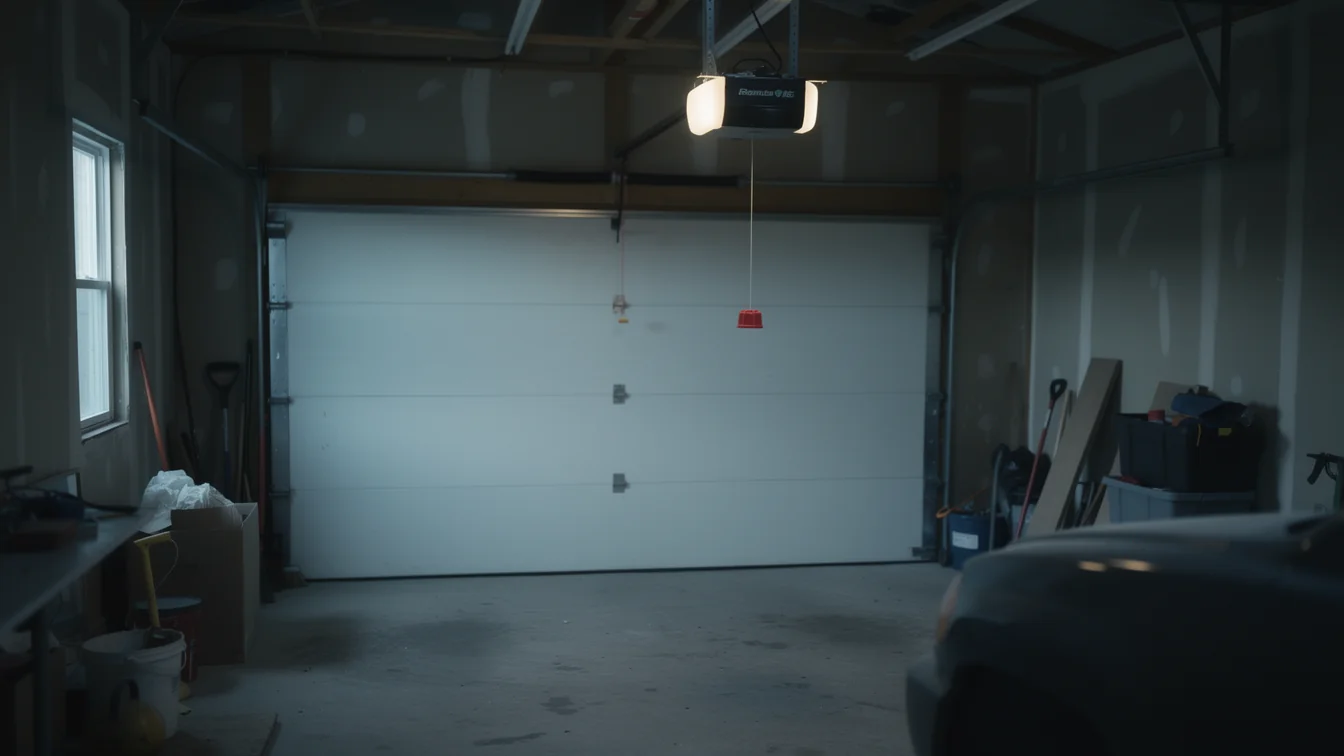
Cold-severe means more than snow on the driveway. It means repeated freeze-thaw cycles through the winter, and each one works on a garage door opener a little differently than steady cold would. The chain or belt drive tightens as temperatures drop. Lubricant that moved fine in September turns to paste. And if a short power outage hits during a cold snap, which is common in a climate this severe, a door without battery backup just sits there, locked in whatever position it was in when the power dropped.
For a house built in the 1960s or 70s, that often means the door is stuck down, because most of these openers spend most of their life in the closed position. The manual release cord still works, in theory, but on an older unit that's rarely been exercised, the release mechanism itself can be stiff or seized. We don't have data on how often that specific failure happens here, so we won't put a number on it, but the combination - old opener, severe cold, a power outage - is the single most common seasonal complaint we see.
What Is Going On
Here's the mechanical story. A garage door opener manufactured for a house built decades ago was not designed with today's battery backup standards in mind. When the grid drops power during a storm, a newer opener with a backup battery keeps running on a trickle charge. An older one just stops, full stop, wherever the door happened to be.
Add the cold-severe climate on top of that and you get a second problem: the torsion spring itself. Springs lose a little tension as steel ages, and cold makes steel more brittle, not more flexible. A spring that's been fine for years can finally let go on the coldest week of the year, because that's when the metal is under the most combined stress - mechanical load plus temperature. This isn't a Mason-specific chemistry trick, it's physics, but it plays out here because so much of the housing stock dates to that 1938-2004 window with the median landing around 1972. That's enough years on the original hardware for fatigue to matter.
One honest limitation: if a spring has already gone, don't try to force the door with the opener. That burns out the motor on top of the spring repair, and now it's two jobs instead of one.
What to Check
Start with the manual release cord. Pull it once, now, before you need it in a power outage - if it's stiff or won't drop the carriage cleanly, that's worth a look before winter, not during it. Second, check whether your opener has a battery backup at all. If the house dates to the original 1960s or 70s build and the opener's never been swapped, the answer is probably no.
Third, listen to the door on a cold morning. A grinding or straining sound on an older torsion spring is a warning, not background noise. Fourth, check the weatherstripping at the bottom panel - in a cold-severe climate, a gap there is how the garage loses heat fast enough to make everything else inside it colder and stiffer than it needs to be.
Last, know your limits. If the opener is original to a house built decades ago and keeps acting up, a tune-up might buy a season, but at some point replacing it costs less than the third service call. We're not going to talk you into fixing something that's done.
Frequently asked questions
Why does my garage door opener stop working when the power goes out in winter?
Unless your opener has a battery backup, losing power means losing the motor entirely, and the door stays wherever it was. Many openers in Mason's older housing stock were installed before battery backup was standard, so a power outage during a cold snap can leave the door stuck closed until power returns or you use the manual release.
Is it normal for my torsion spring to fail in the cold?
Cold doesn't cause the failure by itself, but it adds stress to a spring that's already aging, and steel gets more brittle as it cools. On a house with original hardware from the 1960s or 70s, winter is often when a spring that's been weakening for years finally lets go.
Does my garage need better insulation for winter?
We can't tell you that without seeing the door and the weatherstripping. What we can say is that a cold-severe climate makes any gap at the bottom panel or around the frame work harder against you, so it's worth checking seals before the coldest months, not after.
Related garage door services in Mason
More garage door guides
Book garage door service in Mason
Call now or request a quote - tell us what the door is doing and where you are.