
Mason, OH · Garage Door Service
Garage Door Repair for Mason's Older Torsion Springs
Torsion springs on Mason's 1960s-70s housing stock don't survive the cold-severe winters here. We know the failure, stock the right wire gauge, and fix it right.
- Repairs & new doors
- Springs & openers
- Serving 5 nearby communities
Why This Fails Locally
Most houses in this part of the service area went up between 1938 and 2004, with the heaviest building years clustered in the 1960s and 70s. That matters because a torsion spring is rated for a fixed number of open-close cycles, usually somewhere around 10,000, and a door installed during that building boom has been through that count twice over by now. Add a cold-severe climate band on top of that age, and you get metal fatigue that shows up as a sudden crack instead of a slow weakening. Cold makes galvanized spring wire brittle right where it's already stressed from decades of winding and unwinding. We see this pattern across the 185,723 households and 98,697 owner-occupied houses in this market, and it's the same story every winter: a spring that was fine in October snaps on the first hard freeze. This isn't a workmanship problem on the original install. It's a timing problem - the house's age and the weather both landing on the same part at once.
What You Are Seeing
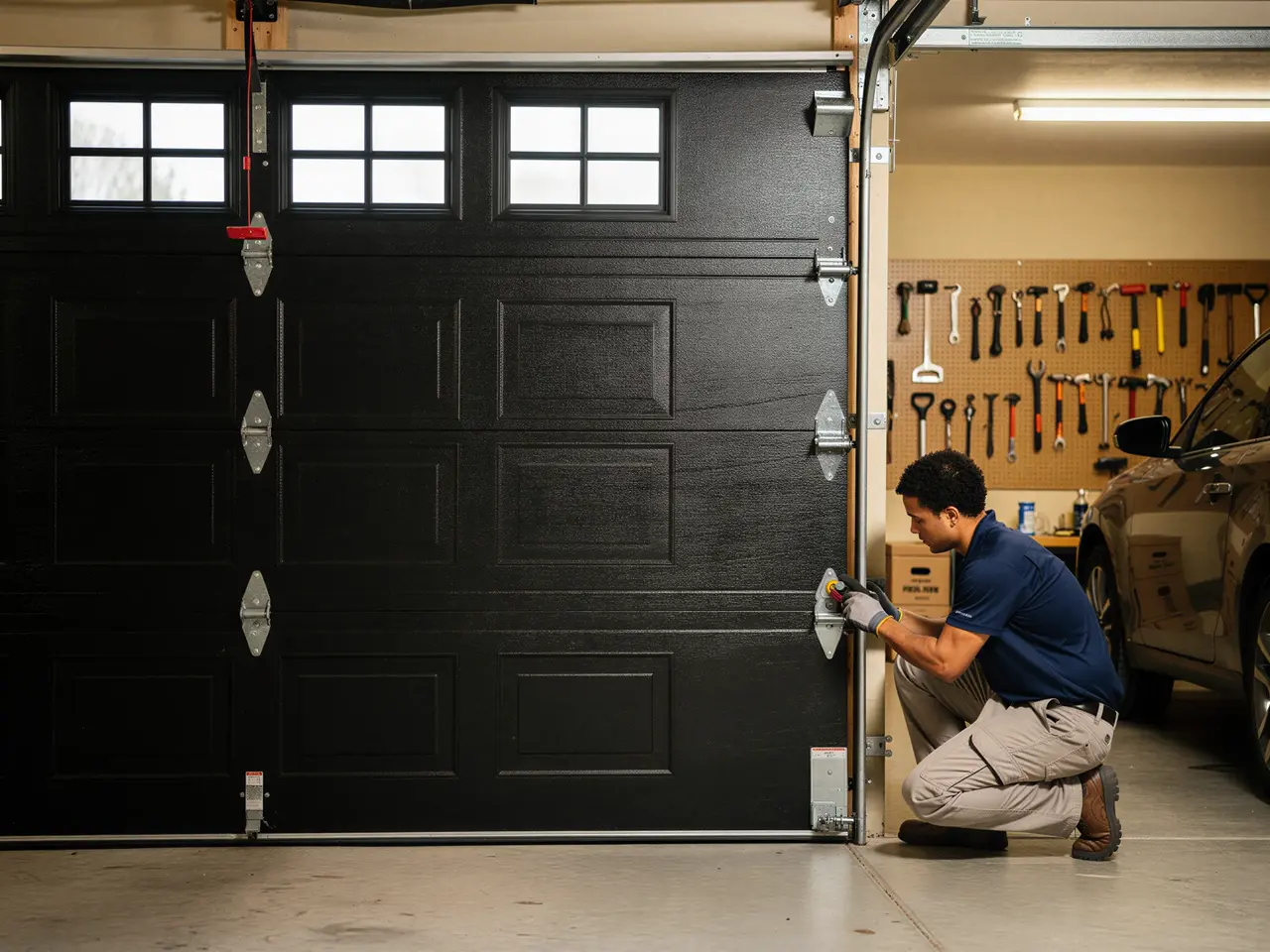
The most common version: you hit the opener button and the door doesn't move, or it moves an inch and stalls. Sometimes there's a loud bang from the garage a few hours earlier - that's the spring letting go on its own, not during use. Look up at the spring bar above the door. If you see a gap of an inch or more in the coil, that spring is broken, not just loose. A door that one person can normally lift should feel like dead weight with a broken torsion spring - if you can lift it without much effort, the spring is probably still holding. On older installs with a single spring instead of a matched pair, the door can also hang crooked on one side after the break, which puts extra strain on whichever cable is still under full tension. Don't keep running the opener against a broken spring - it burns out the motor fast.
What the Fix Involves
We measure the wire diameter, coil length, and inside diameter of the old spring before pulling anything, because a mismatched replacement either underlifts the door or wears out again in a year. On the 1960s and 70s builds common here, we often find a single spring doing the job two springs would do on a newer install - we'll talk through whether to match the original setup or upgrade to a pair, since a pair means one spring failing doesn't leave you stuck. Once the new spring is on, we check cable wear on both sides, since a cable that's been running unevenly under a lopsided load wears faster than it should. Last step is balancing: the door should hold still at any point when disconnected from the opener. If it drifts up or down, the spring tension isn't right yet. One honest limit here - if the drums, shaft, or bearing plates are also worn from the same age and cold, replacing just the spring is a short-term fix, and we'll tell you that up front rather than send you out the door with a repair that won't hold.
Stocked Parts
We carry torsion springs in the wire gauges and lengths that match doors built across the 1938-2004 window that makes up most of this market, along with the drums, cables, and bearing plates that typically go with them. For the standard torsion setups common on 1960s and 70s garages in this area, that means same-visit replacement in most cases. Where we run short is on odd extension-spring configurations from custom or heavier wood doors - those sometimes need a special order, and we'll tell you that on the phone before the truck rolls so you're not waiting on-site for a part we don't have.
Frequently asked questions
Why did my garage door spring break in cold weather?
Cold makes the galvanized wire in a torsion spring more brittle, and if that spring is already near the end of its cycle life - common in houses built in the 1960s and 70s that make up a lot of this area - the cold is often what finally snaps it. It's an age-and-temperature combination, not a defect.
Should I replace one spring or both?
If your door runs on a single torsion spring, as many older installs here do, we'll usually recommend moving to a matched pair so one failure doesn't leave you stuck with a dead door. It costs more up front but means the other side is still holding tension when one gives out.
Can I just wait until the second spring breaks too?
You can, but running a door on one working spring puts extra strain on that spring and on the opener motor, since it's lifting more of the load than it's rated for. It usually fails sooner than it would have on its own.
Is this a DIY repair?
We don't recommend it. A torsion spring is wound under enough tension to cause a serious injury if the winding bars slip, and getting the wire gauge wrong means a door that's either too heavy to lift by hand or that wears the new spring out fast.
By Neighborhood
Garage Door Repair across the Mason area
We also handle garage door repair in these Mason-area suburbs.
Book garage door service in Mason
Call now or request a quote - tell us what the door is doing and where you are.