
Mason, OH · Garage Door Service
Opener Repair for Mason-Area Garage Doors
Opener repair for Mason-area homes built 1938-2004, where cold winters and aging drive hardware wear out gear sets, logic boards, and safety sensors.
- Repairs & new doors
- Springs & openers
- Serving 5 nearby communities
Why This Fails Locally
Most of the houses this company works on went up somewhere between 1938 and 2004, with the bulk of that stock dating to the 1960s and 70s across the 64 named areas we cover. That matters for openers because a unit installed when a house was built, or replaced once in the 80s or 90s, is well past its working life by now. Chain drives from that era use steel gears that were never designed to run 30-plus winters in a severe cold climate.
Cold is the other half of the problem. This region sits in a COLD severe climate band, which means grease inside the opener head thickens every winter, motors draw harder current on startup, and the logic boards that run older units see repeated thermal cycling between a heated house and an unheated garage. None of that is unique to one street - it's the condition every opener in this service area is built into, year after year.
The result is predictable: openers that worked fine through the summer start grinding, humming, or refusing to close as soon as temperatures drop. It's not bad luck. It's a 1970s-era gear set meeting another cold snap in a climate that doesn't let up.
What You Are Seeing
The complaints we hear across this service area cluster into a few patterns. The opener hums but the door doesn't move - usually a stripped gear or a capacitor that's given out in the cold. The door reverses right after it touches the floor - often a safety sensor that's drifted out of alignment or a limit switch setting that's slipped. The remote works from across the street but not from the driveway - a sign the receiver's antenna or logic board is failing, not the remote itself.
On older chain and screw-drive units especially common in houses from the 60s and 70s, we also see the opener run but the door lag behind, which usually means the drive mechanism inside the head has worn separate from the motor. On newer belt-drive units installed as replacements, the complaint is more often a logic board that won't accept programming or a wall control that's stopped responding.
If your opener trips the breaker, smells hot, or has already caught and released the door hard enough to rack the track, that's past a simple repair and into territory where we'll tell you straight that replacement is the better call.
What the Fix Involves
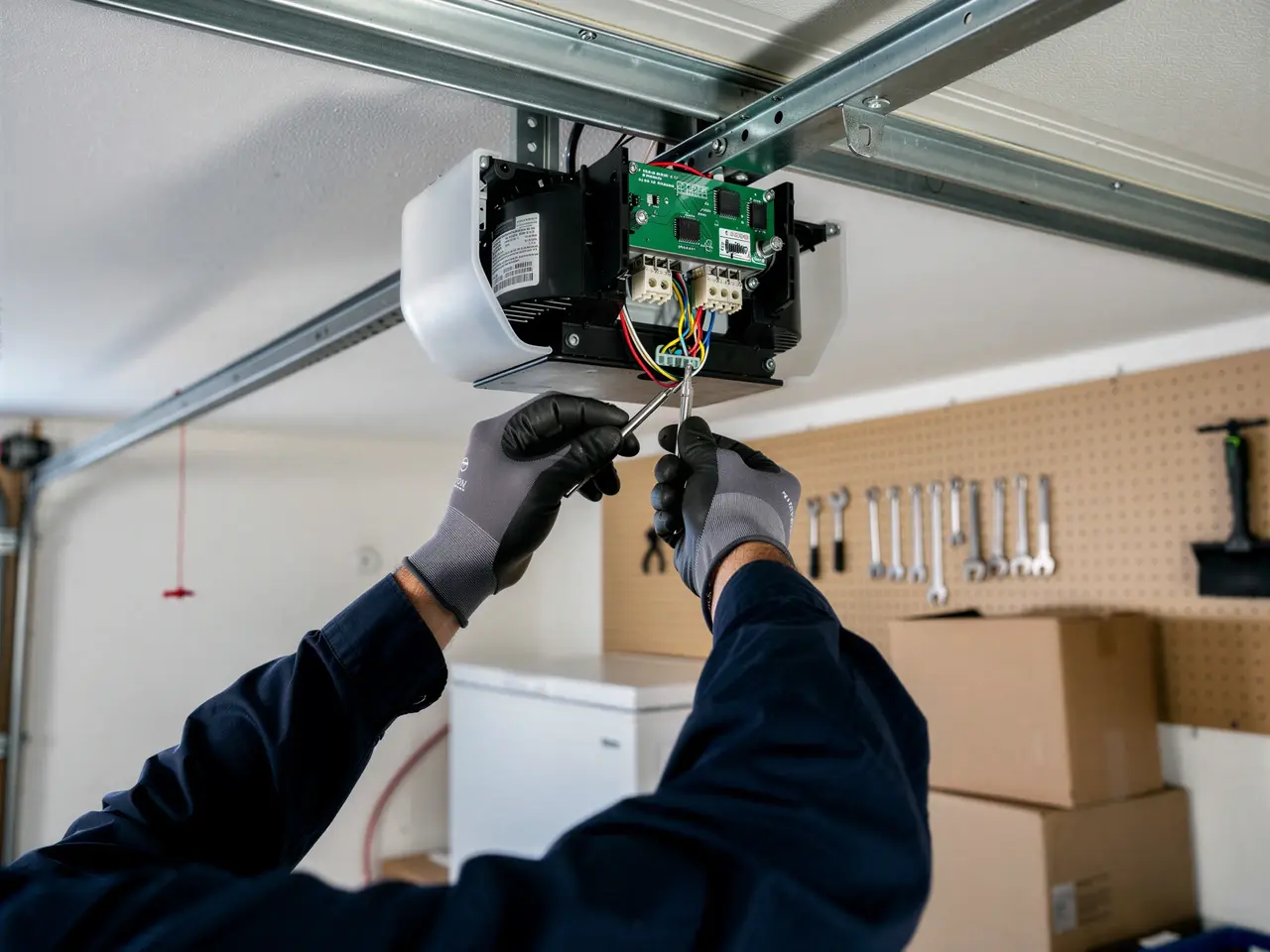
We start by running the opener through its full cycle and watching where it fails - at startup, mid-travel, or on reverse - because that tells us whether we're looking at the motor, the gear set, the logic board, or the sensors before anything gets opened up. On chain and screw drives, a worn drive gear or sprocket is a straightforward swap once we've confirmed it's the cause.
Sensor and limit issues get fixed on site in most cases - realigning the photo-eyes, resetting travel limits, or replacing a sensor that's corroded from humidity swings common in a cold climate garage. Circuit board failures are the trickier call: on some older models the board is no longer made, and at that point we'll tell you plainly that a full opener swap costs less than hunting down a discontinued part and costs you less downtime too.
We don't patch a failing motor with a capacitor swap and call it done - if the motor's drawing hard on every cold start, that's a sign the whole drive unit is near its end, and we'll say so rather than send you into another winter on borrowed time.
Stocked Parts
We carry the parts that fail most often on the opener models common to houses built across this service area's 1938-2004 range: drive gears and sprockets for chain and screw units, photo-eye sensor pairs, wall control stations, and standard remotes and keypads. These go on the truck because they're the calls we run most weeks, not because every job needs them.
What we don't keep on hand are logic boards for discontinued models - some openers from the 80s and 90s used boards the manufacturer stopped making years ago, and if yours is one of them, we'll tell you upfront rather than have you wait on a part that may never arrive. In that case a new opener, which we can usually install the same visit, ends up being the faster and often cheaper fix.
Belt and screw-drive assemblies for current production units are also stocked, since replacement installs are now a regular part of the work across homes where the original 60s and 70s opener finally gave out.
Frequently asked questions
Why does my opener only act up in winter?
This area sits in a severe cold climate band, and cold thickens the grease inside an opener's gear housing while making motors draw harder on startup. An opener that's marginal in summer often fails outright once temperatures drop, which is why winter is when most of these calls come in.
Is it worth repairing an opener from the 1970s?
Sometimes, if the fault is a sensor or limit switch. But a lot of houses in this service area still have original or first-replacement openers from the 60s and 70s, and once the drive gear or the logic board goes on a unit that old, parts are often discontinued and a new opener is the better money.
Can you fix a remote that stopped working?
Usually yes, and it's rarely the remote itself - more often the receiver inside the opener head has failed or lost its antenna connection. We carry standard remotes and keypads on the truck so reprogramming or replacing the handheld is typically a same-visit fix.
Do you repair all opener brands?
We work on the chain, screw, and belt-drive openers common across this service area's housing stock. For boards or parts tied to a specific discontinued model, we'll tell you directly if a part isn't available rather than guess at a timeline.
Related services
Related guides
By Neighborhood
Opener Repair across the Mason area
We also handle opener repair in these Mason-area suburbs.
Book garage door service in Mason
Call now or request a quote - tell us what the door is doing and where you are.