
Mason, OH · Garage Door Service
Garage Door Installation for Mason, Ohio Homes
Garage door installation in Mason, OH, matched to the 1938-2004 housing stock here and rated for cold winters, with torsion springs stocked on the truck.
- Repairs & new doors
- Springs & openers
- Serving 5 nearby communities
Why This Fails Locally
Most of the houses in Mason went up between 1938 and 2004, with the bulk clustered in the 1960s and 70s, which means a lot of original one-car and two-car openings sized for doors that don't match what's sold today. A rough opening framed for a 1968 steel panel door isn't always the same width as a current production model, and the jamb detail around it is often original too. That mismatch is the single biggest reason an install here isn't a drop-in swap.
Mason sits in a cold-climate band with severe winter stress on a garage door system. An uninsulated single-layer panel from that era was never built to hold a thermal break, so the garage runs cold, the slab sweats, and the hardware - hinges, rollers, the bottom seal - takes more freeze-thaw cycling than it would in a milder spot. Add decades of settling on a 50-plus-year-old foundation and the opening itself is rarely square anymore, which complicates a straight swap even when the width is close. None of this is a defect in the house. It's just what happens to a mid-century opening after this many winters.
What You Are Seeing
The door looks tired before it fails outright: a visible gap along the bottom seal even when it's down, daylight at the corners, a panel that's slightly bowed or dented from age rather than impact. The opener strains harder than it used to, or the door drops the last foot instead of lowering evenly - a sign the track and the opening it rides in have drifted out of true.
Some homeowners call us after a storm door or a new paint job makes the old garage door look worse by comparison, not because anything broke. Others call because the energy bill prompted a look at the garage, and an uninsulated single-wall door with no thermal break is an obvious gap once you know to check it. Either way, the fix usually isn't patching the old door - a door built in the 1960s or 70s doesn't take well to new hardware bolted onto old steel, and parts for that generation of track and panel aren't something anyone stocks anymore.
What the Fix Involves
We start by measuring the actual opening, not the door you have - on a house this age the two aren't always the same number, and jamb and header condition get checked before we quote anything. If the opening has shifted, that gets corrected first; a new door hung in an out-of-square frame fails the same way the old one did, just faster.
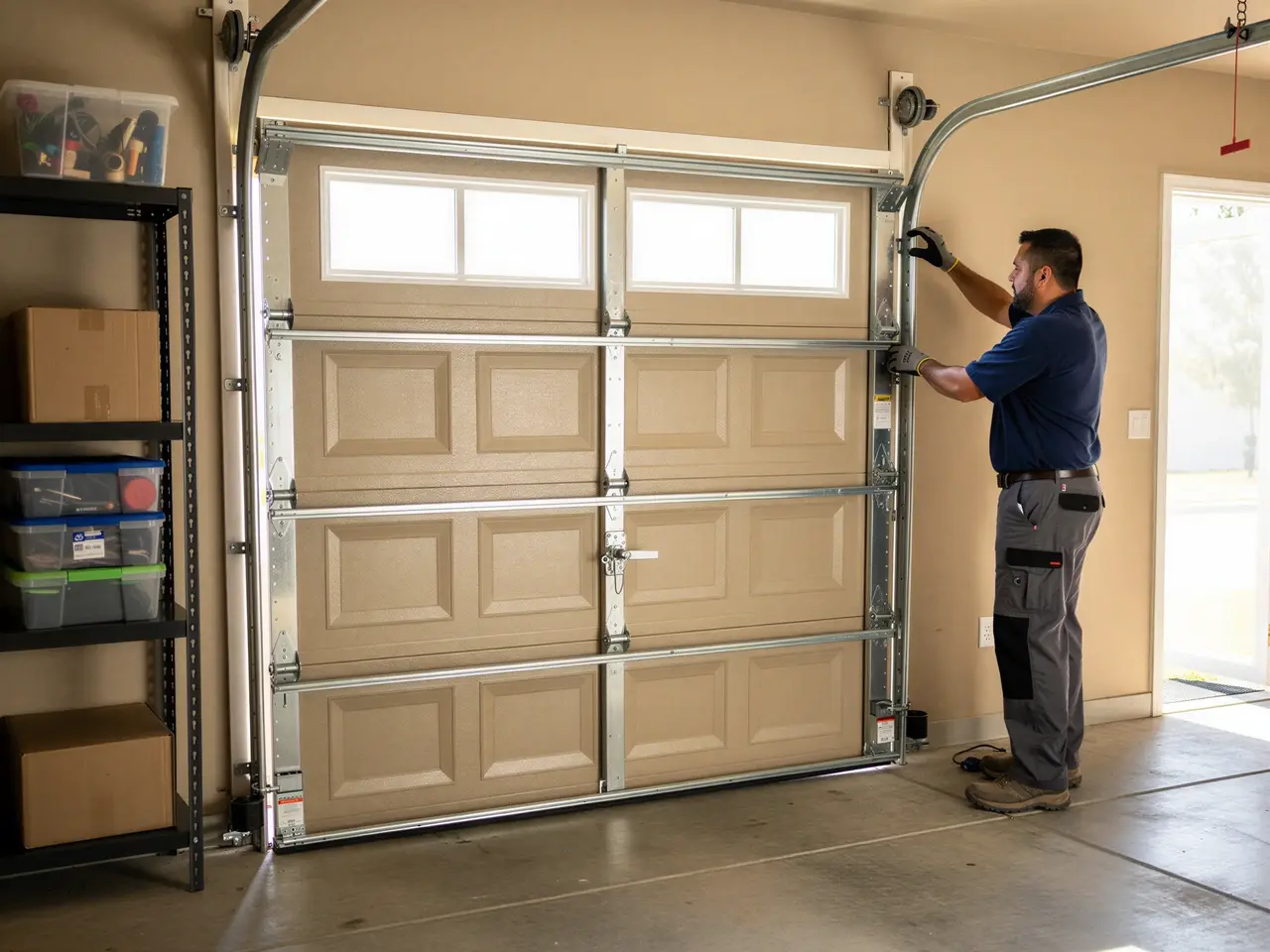
From there it's a standard install: new track set plumb to the corrected opening, insulated steel panel sections sized to the span, and a spring system matched to the actual door weight rather than guessed at. Weatherstrip and bottom seal get picked for the cold-climate exposure this house sees every winter, not a generic warm-weather gasket. The opener gets reinstalled or replaced depending on its condition - we'll tell you straight if the existing unit is fine to keep, because not every job needs a new one.
One limitation worth saying plainly: if the header or framing around the opening has rotted or shifted enough, that carpentry work isn't something we do as part of a door install, and we'll say so before the job starts rather than after.
Stocked Parts
With a median household income of $79,735 across this service area, most Mason homeowners replacing a door choose a mid-tier insulated steel model rather than the cheapest single-layer panel, and that's what we keep on the truck in the widths that match 1960s and 70s openings. Torsion springs are sized to actual door weight on the spot rather than ordered after the fact - across the 185,723 households and roughly 98,697 owner-occupied houses in this service area, a correctly sized torsion spring is the part we install most.
We also install across nearby communities like Landen and Kings Mills, both about three miles out, and Wetherington and South Lebanon a bit further, where the same era of housing stock and the same winter exposure make the job nearly identical to one in Mason itself. Cold-rated weatherstrip and bottom seal are stocked standard, not special-order, because a warm-climate gasket doesn't hold up through a season here.
Frequently asked questions
Will a new garage door fit my old opening without carpentry work?
Usually yes, but not always. Houses built in the 1960s and 70s often have openings that have shifted slightly over the decades. We measure the actual opening before quoting, and if the jamb or header needs repair first, we tell you - that carpentry isn't part of our install scope.
Do I need an insulated door in Mason?
Given the cold winters this area sees, an insulated steel panel holds up better than a single-layer door and keeps the garage noticeably warmer. It's not required, but it's what most homeowners here choose once they see the difference in a cold garage.
How is the spring sized for a new installation?
We size the torsion spring to the actual installed door weight, measured on site, not to a generic chart. This matters more on older openings where the door and track aren't always standard dimensions.
Can you keep my existing opener with a new door?
Often, yes. If the opener is in good shape and rated for the new door's weight, we reinstall it rather than replace it. We'll tell you plainly if it's not a good match for the new door instead of selling you one you don't need.
Book garage door service in Mason
Call now or request a quote - tell us what the door is doing and where you are.