
Mason, OH · Garage Door Service
Why Your Safety Sensors Keep Drifting in Mason
Mason homes from the 1960s and 70s often have sensor brackets bolted onto old track hardware. Cold slab movement and condensation throw them off. Here's what's actually going on.
- Repairs & new doors
- Springs & openers
- Serving 5 nearby communities
How Local Conditions Play In
Housing in this area went up mostly between 1938 and 2004, with the bulk of it concentrated in the 1960s and 70s - a pattern that holds across the 64 named neighborhoods in this part of the county, from Landen and Kings Mills in close to Wetherington and South Lebanon a few miles out. Federal rules requiring photo-eye safety sensors on garage openers didn't take effect until 1993. That means a huge share of the openers running today in Mason were installed on slabs and track systems built decades before sensors existed, then retrofitted later - sometimes well later, on a second or third opener swap.
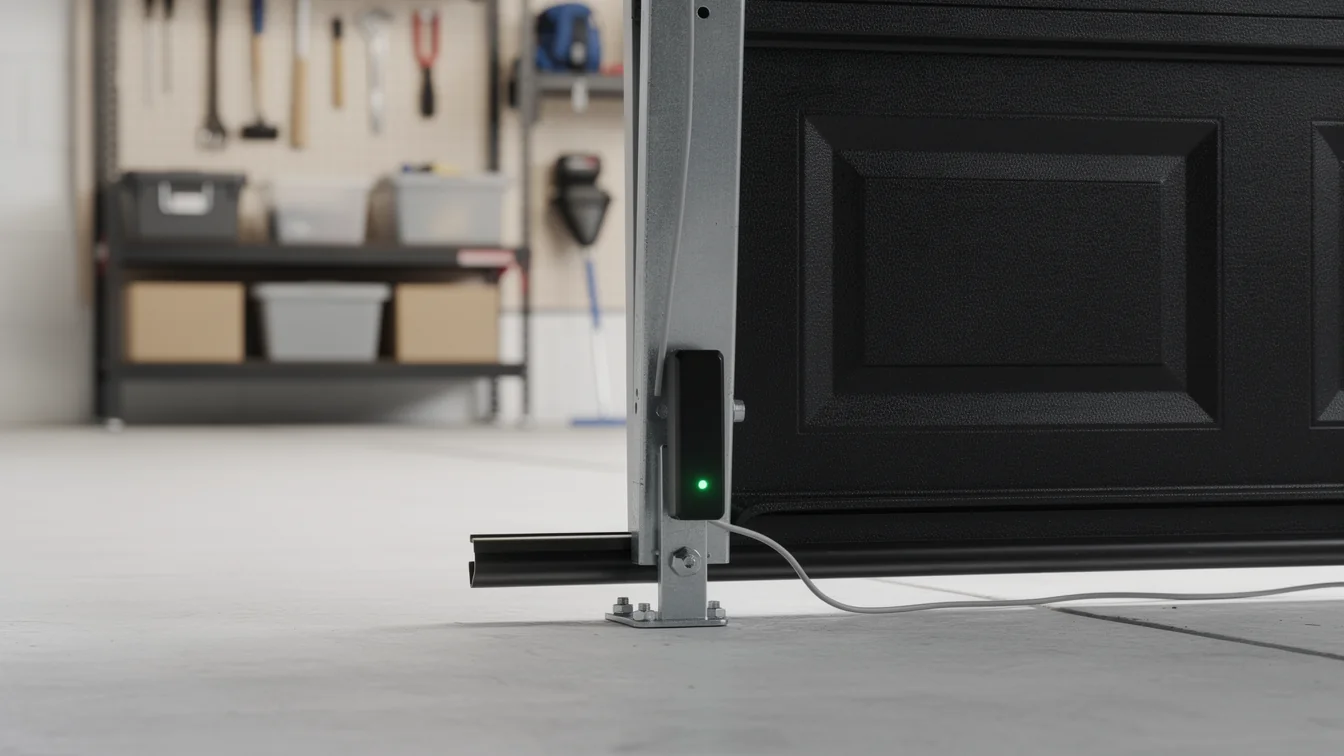
A retrofit sensor bracket is usually a thin metal tab screwed or zip-tied onto whatever part of the track happened to be closest to the floor. It was never engineered into the original 1960s or 70s installation the way a factory bracket on a newer system is. Over fifty-plus years, that track has been bumped, the slab underneath has settled unevenly, and the wood jamb it's anchored to has shrunk a little with every dry winter. None of that is dramatic on its own. Add it up and the sensor eyes end up aimed a few degrees off true, which is more than enough to make them unreliable.
This isn't a Mason-specific defect - it's what happens to equipment layered onto housing stock this old, in a region that puts the slab and the hardware through real seasonal stress every year.
The Seasonal Bit
This area sits in a climate band rated cold and severe, which means real freeze-thaw cycling every winter, not an occasional cold snap. Concrete slabs expand and contract with that cycling, and a garage slab poured anywhere from the late 1930s through the early 2000s has been through this dozens of times. Each cycle moves the slab a fraction of an inch. The sensor brackets mounted near floor level ride along with it, and the two eyes that were pointed dead-on at installation slowly stop lining up with each other.
There's a second seasonal problem that has nothing to do with the slab. When outside temperatures drop hard and the garage stays a little warmer - even just from a water heater or an adjoining wall to the house - humid air inside the garage hits the cold sensor lenses and beads up as condensation. The opener's logic doesn't know the difference between a film of water on the lens and an actual obstruction in the door's path. It just refuses to close, or it closes and immediately reverses.
Both of these are seasonal in the literal sense: they show up hardest in the coldest stretch of winter and ease off once things warm up. If your door's sensor trouble tracks the thermometer, that's not a coincidence - that's the climate doing exactly what it does to slabs and brackets every year.
What Is Going On
Put the two things together - 1960s-70s construction with retrofit hardware, and a cold climate that moves slabs every winter - and you get sensors that were never on rock-solid mounts, sitting on brackets that shift a little more each freeze-thaw cycle. The fix isn't usually a new sensor. The sensors themselves are simple and rarely fail outright. What fails is the aim: one eye tips a degree or two relative to the other, the invisible beam between them stops lining up, and the opener reads that as a break in the circuit.
On the older retrofit installs common across this housing stock, the bracket itself can be part of the problem - thin metal that flexes, or a mounting screw sunk into wood that's loosened over the decades. Tightening the screw and re-aiming the eye sometimes holds for a season. Sometimes it doesn't, because the wood behind it is too far gone to hold a screw properly anymore.
Here's the honest limitation: on some of the oldest track-mounted setups, there's no clean way to retrofit a sensor bracket that will stay put long-term. In those cases the right call is replacing the bracket mount entirely, not re-aiming the same worn hardware every few months. We'll tell you straight if that's where your door is at before we charge you for another alignment visit.
What to Check
Before you call anyone, look at both sensor eyes from outside the garage, down near the floor on either side of the door. Wipe each lens with a dry cloth - condensation and dust both read as obstructions. Check that the small indicator light on each sensor is solid, not blinking; a blinking light usually means the beam isn't connecting at all.
Next, look at how each bracket is mounted. If you can wiggle the bracket by hand, or if it's held on with a zip tie instead of a screw into solid wood or metal, that's your likely culprit - not the sensor itself. Press gently on the slab right at the base of the track on both sides; on older installs you'll sometimes feel or see a hairline gap where slab and frame have parted slightly over the years.
If the door reverses only in the coldest part of the morning and behaves fine by afternoon, that points to condensation, not a bad sensor or a bent bracket - give the lenses a wipe before you assume anything's broken. If misalignment keeps coming back within weeks of a fix, the bracket mount is probably past the point where re-aiming is worth doing again.
Frequently asked questions
Why does my garage door reverse right when I'm trying to close it on cold mornings?
Likely condensation on the sensor lenses, not a mechanical fault. When the garage is a little warmer than the outside air during a hard freeze, moisture beads on the lenses and the opener reads it as something blocking the door's path. Wipe both lenses dry and try again before assuming the sensor itself has failed.
My house was built in the 60s - why do the sensors seem flimsy?
Photo-eye sensors weren't required until 1993, so most openers in houses from that era had them added later, often with a thin bracket screwed or zip-tied onto existing track hardware rather than a factory mount. Those retrofit brackets flex and loosen over decades, which is usually why alignment keeps drifting.
I keep re-aiming the sensors and they keep drifting again a few weeks later. Is that normal?
It happens often on older retrofit mounts, especially through a cold winter with repeated freeze-thaw cycling of the slab. If re-aiming doesn't hold, the problem is usually the bracket mount itself, not the sensor. At that point replacing the mount is a better use of your money than another alignment visit.
Related garage door services in Mason
More garage door guides
Book garage door service in Mason
Call now or request a quote - tell us what the door is doing and where you are.