
Mason, OH · Garage Door Service
Weather Seals and Drafts: Why Mason Garage Doors Fight Winter Harder
How Mason's 1960s-70s housing stock and cold-severe winters wear out garage door seals, and what to check before the next freeze hits your door.
- Repairs & new doors
- Springs & openers
- Serving 5 nearby communities
How Local Conditions Play In
Mason's housing didn't spring up all at once. Homes here went up anywhere from 1938 to 2004, with the median landing around 1972 - meaning a lot of garages still carry hardware and seal tracks sized for a door that's now over fifty years old. Drive three miles out to Landen or Kings Mills, or four to Wetherington and South Lebanon, and you'll find the same story repeating: pockets of 1960s and 70s construction stacked up across the 64 named areas that make up this part of Warren County. That matters for seals specifically, because the rubber and vinyl gasket systems standard on doors today weren't the norm when most of this housing stock went in. A lot of garages were fitted later with seals that are a size or a style off from what the original door track wants, and that mismatch is where drafts start. It's not a flaw in any one house - it's what happens when a region's building stock ages faster than the parts supply chain catches up. If your door was installed anywhere near the neighborhood's build era, the seal under it has probably already outlived at least one replacement cycle, whether anyone noticed or not.
The Seasonal Bit
Mason sits in a cold-severe climate band, and that's not a marketing phrase - it's the reason seals fail here on a schedule rather than at random. Rubber and vinyl gaskets contract when the temperature drops, and in a climate that swings hard between freeze and thaw, that contraction happens over and over through a single winter. Each cycle leaves the seal a little less pliable. By February, a seal that sealed fine in October can have a visible gap at the corners, usually at the bottom panel where cold concrete meets rubber directly. This isn't a one-time event you can fix once and forget - it's a yearly wear pattern tied directly to how many freeze-thaw swings the season throws at the door. A door that seals tight in September can be letting in a cold draft by January without a single mechanical part failing. The seal itself is just worn out from doing its job in weather it wasn't built to flex through indefinitely. That's the piece homeowners miss: the hardware is usually fine. It's the soft parts that give out first, every single winter, right on schedule.
What Is Going On
When a seal stiffens, it stops doing the one thing it's there for: closing the gap between the door and the floor or jamb. Cold makes vinyl and rubber lose flexibility, so a seal that used to compress against concrete now just rests on top of it, leaving a thin channel for air to move through. On an older door from Mason's 1960s-70s building wave, that gap often isn't uniform either - decades of settling have shifted slabs and frames just enough that the door and the floor no longer meet square. A new seal can mask a lot of that, but it can't fix a floor that's dropped a quarter inch at one corner. We see this most on side-mounted torsion setups from that era, where the track itself has a bit of play built in from age, so the seal has to work harder to compensate for movement the hardware was never built to limit this tightly. Drafts show up as the symptom, but the underlying cause is almost always a combination of worn seal material and decades of small structural shift - not a sudden failure, just years catching up at once.
What to Check
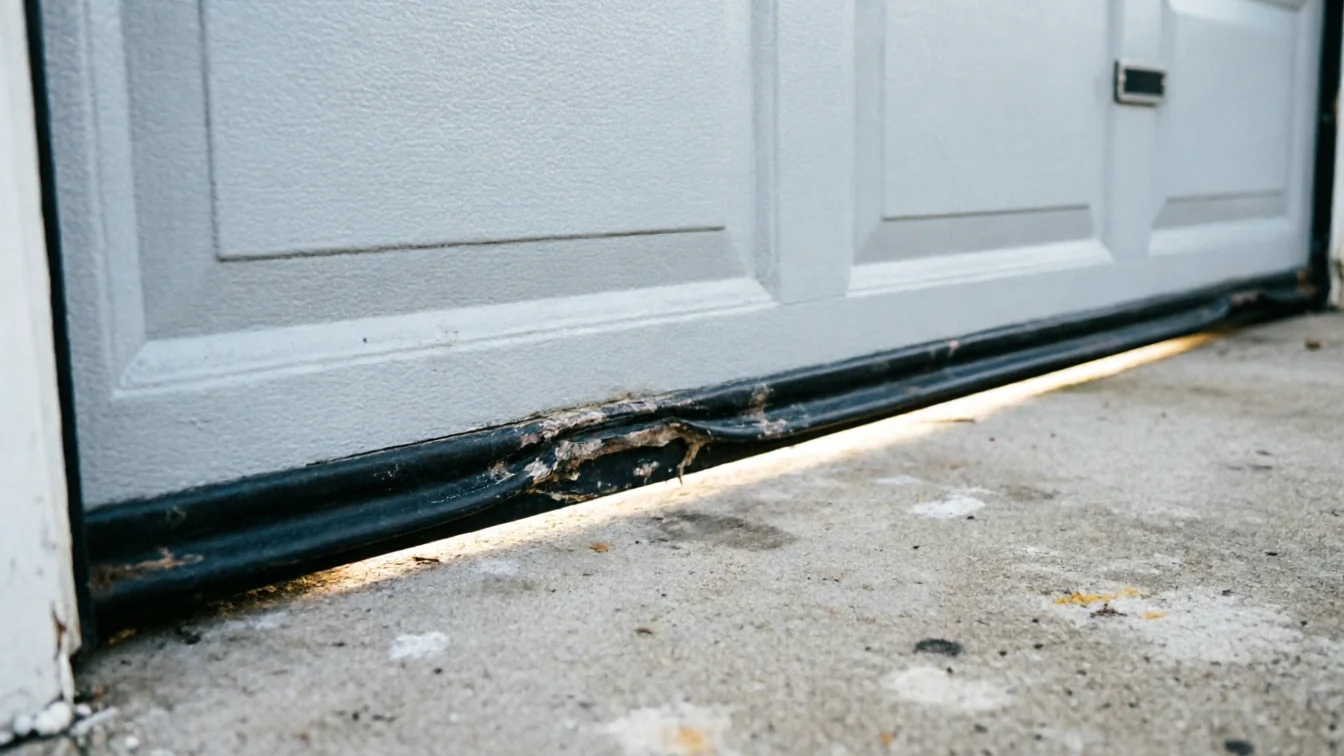
Start at the bottom seal and run your hand along it on a cold morning - if you feel moving air anywhere along the run, that's your leak point, not just a vague draft. Check the corners first; that's where compression fails earliest. Next, look at the side seals where the door meets the jamb, especially on doors installed before double-sided foam-backed seals became common. If the vinyl has gone stiff enough to crack when you bend it, it's past lubricating and needs replacing outright - no amount of silicone spray brings dried-out vinyl back to flexible, and we won't tell you otherwise just to sell a visit. Also check the bottom corners of the panel itself for daylight gaps when the door's closed; on older stock from this area, panel sag can open a gap the seal alone can't close. If you're only losing a little warmth at one corner, a seal swap usually handles it. If the whole bottom edge gaps unevenly, that's often the floor or the door, not the seal, and that's a different job entirely.
Frequently asked questions
Why does my garage door only draft in winter, not summer?
Vinyl and rubber seals contract in cold temperatures, which is exactly the condition Mason's cold-severe climate band produces repeatedly through winter. The seal material stiffens and pulls back from full contact with the floor or jamb. In warmer months the same material stays pliable enough to seal the gap, so the draft disappears until temperatures drop again the following year.
My house was built in the 1970s - is that why the seal doesn't fit right?
It can be. A lot of Mason's housing stock dates to that era, and doors or seals replaced since then aren't always matched to the original track dimensions. If a seal was swapped in without checking the track width, you'll get gaps at the corners even with new material. Worth checking the fit, not just the age, of the current seal.
Can I just caulk the gap instead of replacing the seal?
Caulk isn't made to flex the way a door seal needs to every time the door opens and closes, so it cracks and fails fast in this kind of freeze-thaw climate. It might buy you a few weeks, not a season. A proper compressible seal rated for cold climates holds up far longer under the same movement.
Related garage door services in Mason
More garage door guides
Book garage door service in Mason
Call now or request a quote - tell us what the door is doing and where you are.