
Mason, OH · Garage Door Service
Why Mason's Houses and Winters Gang Up on Garage Doors
Mason's 1960s-70s housing stock meets a cold, severe climate band - here's how that combination breaks springs, openers, and tracks, and what to check before it does.
- Repairs & new doors
- Springs & openers
- Serving 5 nearby communities
How Local Conditions Play In
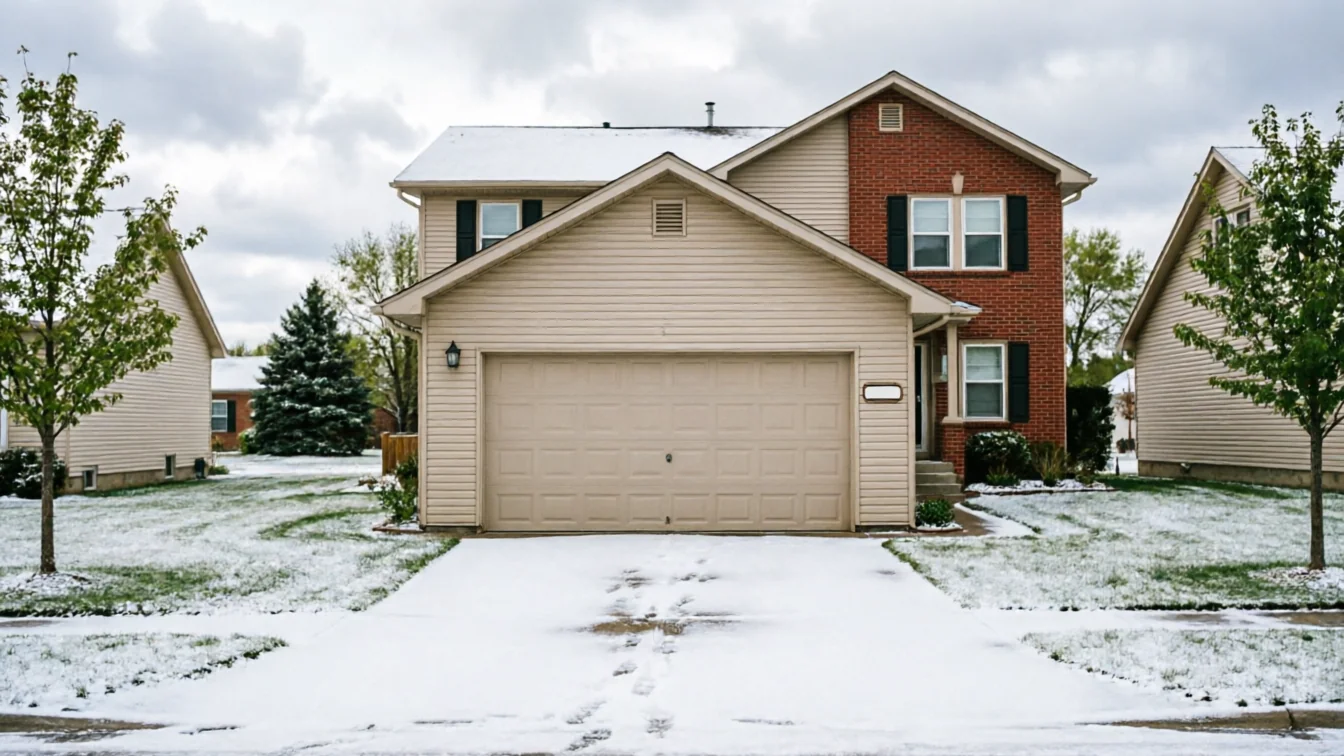
Mason's housing stock runs from 1938 to 2004, with the median build year sitting at 1972 and most of the neighborhoods you'd recognize - the stretches near Landen, Kings Mills, and Wetherington - built out in the 1960s and 70s. That matters more than people think. A door and opener installed when a house was framed in 1968 has had over fifty years to cycle through heat, cold, and humidity, and most of that original hardware was never designed with today's insulated panels or heavier openers in mind.
Across the wider service area there are roughly 98,697 owner-occupied houses out of 185,723 households, and a large share of those are still running torsion springs and track hardware that's older than the current owner's tenure in the house. When a spring is original to a house built in 1965, it isn't a question of if it fails, it's when - and the when tends to line up with the first hard cold snap of the year.
This isn't a scare story. It's just what happens when 1960s-era steel meets a winter that puts real stress on it. The fix is knowing what to look at before the door won't open on a Tuesday morning.
The Seasonal Bit
The federal climate data puts this area in a cold, severe band, and that's the detail that drives most of the winter service calls. Steel contracts in the cold. A torsion spring that's been slowly fatiguing for forty years doesn't need much of a push to finally let go, and a hard freeze overnight is exactly that push.
Cold also thickens the grease in older rollers and hinges, which is why a door that opened fine in October suddenly groans or binds in January. On houses built before insulated doors were standard - which covers a good chunk of the 1938-2004 range here - the wood or thin steel panel itself can warp slightly as temperatures swing, throwing the door out of square in the tracks.
We're not going to tell you to warm up your garage to 70 degrees before opening the door, because most people don't heat an attached garage that way. What's worth knowing is that the first cold snap of the season is when weak springs and tired openers show their hand, not sometime in the middle of winter. If your door has been sluggish since fall, cold weather is the thing that turns sluggish into broken.
What Is Going On
Put the housing age and the climate together and you get a specific, recurring failure pattern in this area. Original torsion springs on houses from the 1960s and 70s - common on the Mason side near Kings Mills and South Lebanon - are rated for a finite number of open-close cycles, and a severe cold spell accelerates the fatigue that's already built up over decades. The spring doesn't fail because of one cold morning; it fails because one cold morning was the last straw on top of fifty years of cycles.
On newer construction, closer to the 2000s end of that 1938-2004 range, the issue is usually different: openers with sensors or circuit boards that get finicky in cold garages, not springs. So the age of the specific house changes what you're actually troubleshooting.
Here's the honest limitation: we can't tell you which one it is without looking at the door. A spring that's visibly stretched or has a gap when the door is down is a spring problem. An opener that hums but doesn't move the door, or that only responds intermittently in cold weather, usually points to the opener instead. Guessing wrong means paying for a part you didn't need.
What to Check
Before you call anyone, a few things take two minutes and tell you a lot. Look at the torsion spring above the door - if you see a visible gap in the coil or it looks stretched compared to its resting shape, that's a spring near the end of its life, and cold weather is likely to finish it off. Listen for grinding or popping when the door moves; on a house from the 1960s or 70s with original hardware, that's often the rollers, not the opener.
Check whether the door is heavier to lift by hand (with the opener disconnected) than it used to be. A door that's gotten noticeably heavier over a season is telling you the spring is losing tension, which cold weather will expose fast.
If your opener has been slow to respond or skips a cycle only on the coldest mornings, that's consistent with aging electronics rather than a mechanical problem, and it's worth mentioning when you call, since it changes what gets checked first.
We can't quote a price or a timeline here without seeing the door - that depends on what's actually wrong and what parts are on the truck that day.
Frequently asked questions
Why did my garage door spring break on such a cold morning?
It's rarely just the cold. A torsion spring on a house built in the 1960s or 70s has usually been cycling for decades already, and a severe cold spell adds enough extra stress to finish off a spring that was already near the end of its rated life. The cold is the trigger, not the root cause.
Is my opener or my spring the problem in winter?
If the door feels heavier to lift by hand or you see a gap in the spring coil, that points to the spring. If the opener hums or responds only intermittently in cold weather but the door itself isn't hard to lift, that's more likely the opener's electronics reacting to cold.
Does the age of my house matter for garage door problems?
Yes. Houses here were built between 1938 and 2004, with most dating to the 1960s and 70s. Older houses are more likely to have original torsion springs nearing failure, while newer builds in that range more often have opener or sensor issues instead.
Related garage door services in Mason
More garage door guides
Book garage door service in Mason
Call now or request a quote - tell us what the door is doing and where you are.